Building a Personal Fund Management System With Hermes
How I turned scattered trading work into a governed research and operations system.
The agents handle research, scanning, evidence, dashboards, and reporting. I remain responsible for strategy logic, risk rules, source validation, and final decisions.
At a glance
Role: Strategy owner, system designer, risk governor, and final reviewer.
Stack: Hermes Agent, specialized agents, Python, scheduled jobs, Discord, structured ledgers, and TDH dashboards.
Status: Active personal research and operations system. This is not a fund offering, financial advice, or a performance guarantee.
The short version is simple: Hermes does not replace the strategy or make market risk disappear. It turns trading judgment into explicit rules, keeps repetitive operations moving, and makes the evidence harder to ignore.
Most people hear “AI trading” and ask, “Can it tell me what coin to buy?” I think that is the wrong question.
Can AI turn a manual trading process into a repeatable, measurable, autonomous, and testable operating system?
That is the question I built this system to answer. I run Hermes like a small research and operations desk, with specialized agents handling defined jobs around my strategies. The point is not magical prediction. The point is disciplined operations.
The shift from scattered trading to an operating system
Before Hermes, a lot of my strategy work lived in the usual places:
- Screenshots and chart annotations.
- TradingView tabs and watchlists.
- Notes and Discord messages.
- Random backtests that were hard to compare.
- Memory, intuition, and the occasional “I swear this pattern works.”
- Vibes, unfortunately.
That can work for a while. It becomes a problem when you want to scale the process or answer hard questions consistently. Which setup actually works? Which version is better? What invalidates it? Which exit model is helping? Under what conditions does it fail? Are we improving the edge, or only renaming the same idea?
A setup either has rules or it does not. If it has rules, the system should be able to test it, track it, compare it, improve it, and show me when the evidence disagrees with my memory.
The system around the signal
When I say “personal fund management system,” I am not claiming to operate a Wall Street fund or offer investment management. I mean that I built the operational support a serious strategy needs around the signal.
- Research and data gathering.
- Rule definition and strategy specifications.
- Market and watchlist scanning.
- Setup detection and validation.
- Backtesting and forward observation.
- Variant and exit-model comparison.
- Risk, reward, and outcome tracking.
- Journaling and trade review.
- Dashboard publication and freshness checks.
- Discord alerts, daily reports, and weekly reviews.
- Monitoring, failure handling, and iteration.
A strategy without this operating layer is still an idea. Once the system around it is running, I can see whether the idea deserves more testing, needs revision, or should be retired.
Architecture: one governed research loop
The system is autonomous, not unsupervised. Hermes and the agents keep the operation moving, but I remain responsible for strategy design, risk rules, source validation, anomaly review, and final decisions.
The five-part workflow
1. Turn discretionary setups into explicit rules
Many traders can recognize a setup on a chart but cannot describe it precisely enough to test. They understand trend, liquidity, reclaim levels, sweeps, failed breakdowns, compression, expansion, and exit behavior. The challenge is converting that recognition into a specification.
For each strategy, I define the setup type, market condition, entry model, stop behavior, invalidation, exit model, risk and reward assumptions, timeframe, liquidity context, and review rules. I do not publish the proprietary thresholds or exact strategy logic, but the operating principle is public:
Replace “I know it when I see it” with “this matches the written rules.”
Once the rules are explicit, the strategy becomes easier to test, automate, teach, compare, and execute consistently under pressure.
2. Keep materially different variants separate
One of the easiest ways to fool yourself is to combine every version of a setup and call it one strategy. In reality, five different variants may be wearing the same hoodie.
The system separates variants by exit method, take-profit behavior, daily caps, risk and reward profile, filters, and market conditions. This keeps a weak version from hiding behind a stronger one and makes the actual source of performance easier to investigate.
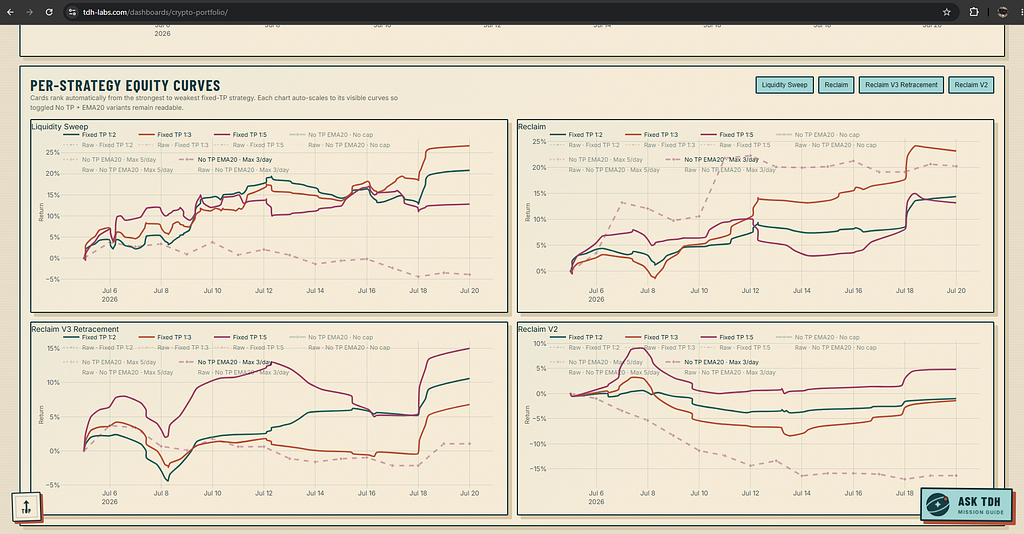
The equity curves in the lead image are useful because they show strategies and variants as separate evidence streams. The chart is not a promise about future performance. It is an operating surface for comparison.
3. Let agents scan without surrendering governance
The agents continuously check approved markets, watchlists, and strategy conditions. If something qualifies, the system routes an update. If nothing qualifies, it stays quiet.
This removes the need to babysit every chart all day. I can sleep, work, take a walk, or pretend I am finally going to organize Notion. The repetitive scan continues without turning every market movement into a forced trade.
Automation does not mean every candidate should be executed. Deterministic rules, source freshness, risk limits, and human review remain part of the operating design.
4. Generate reports that do not care about my ego
The daily report covers market context, detected setups, registered outcomes, invalid cases, and items that need review. The weekly report zooms out and asks a more valuable question: are we finding useful evidence, or only keeping ourselves busy?
The reporting layer connects raw records to decisions. It can highlight stale data, missing outcomes, inconsistent variants, and changes in strategy behavior. Sometimes the answer hurts a little. I would still rather know.
Reports also create accountability. A clean screenshot cannot quietly replace the complete record when the losing examples remain in the same ledger.
5. Review the operation like a business, not a casino
If a setup fails, I inspect the rule and the context. If one variant underperforms, I compare it with the others. If an exit model is weak, I test another one. If a filter appears to remove useful cases, I examine the data instead of defending the original idea.
This is the operations mindset I want in my own trading. Not because it sounds fancy, but because serious work needs definitions, records, review cycles, and clear reasons for change.
What Hermes actually gives me
The biggest unlock is not one perfect bot. It is a coordinated team of tools and agents that help me think, test, document, monitor, and report.
- A research agent can collect and organize relevant context.
- A monitoring agent can watch schedules, data freshness, and operating health.
- A strategy agent can support structured tests without silently changing the rules.
- A reporting agent can summarize evidence and unresolved review items.
- A dashboard builder can publish approved, privacy-limited results.
- A routing agent can deliver updates to the correct Discord destination.
- Hermes can coordinate the roles, files, memory, tools, and schedules around them.
That is the difference between asking AI random questions and running an actual system. The value comes from role boundaries, durable evidence, repeatable operations, and accountable review.
Reliability, safety, and privacy boundaries
A useful trading-operations system needs more than a happy path. Mine is designed around practical boundaries:
- Human strategy ownership: Agents do not invent or silently revise the core strategy.
- Deterministic validation: Symbols, timestamps, required fields, and allowed actions are checked outside model prose.
- Version separation: Strategy and exit variants keep distinct records instead of sharing one blended result.
- Source freshness: Dashboards and reports carry timestamps so stale data is visible.
- Replayable evidence: Important decisions should be traceable to inputs, records, and the version that produced them.
- Failure handling: Retries, deduplication, health checks, and calm alerts are part of the operation.
- Public redaction: Exact entries, stops, private paths, identifiers, and proprietary rules remain outside the public payload.
- Risk disclosure: Research evidence and operating quality do not guarantee future returns.
Large language models can be inaccurate, stale, or overconfident. The system is built to constrain where they help and keep deterministic controls around sensitive actions.
What changed for me
The outcome I can support publicly is a process change, not a profit promise. Strategy work that used to be scattered now moves through written rules, scheduled operations, separate variant records, dashboards, and repeatable reviews.
I spend less time repeating the same scans and more time examining the evidence. Weak ideas are easier to challenge. Strong-looking variants still have to survive additional observation. Open questions are visible instead of living only in my head.
The system also gave me a clearer product insight: traders do not only need another indicator. They need an operating system around research, testing, monitoring, reporting, and accountability.
Who this model can help
The same structure can support other serious trading workflows without pretending that AI predicts markets:
- A trader can turn personal setups into written, testable rules.
- A trading group can compare strategies without blending incompatible variants.
- An educator can give students a consistent review and evidence process.
- A signal team can improve reporting, traceability, and operating health.
- A small research desk can coordinate scanning and reporting without hiring a full operations floor.
The scope should match the real workflow. Some systems need research and alerts only. Others may need backtesting, dashboards, broker-connected operations, or more human approvals. The architecture should make those boundaries explicit before implementation.
What I would improve next
This system is still an evolving laboratory. The next improvements are less glamorous than “predict the market,” and much more useful:
- Stronger source lineage from every public metric back to its canonical record.
- More automated stale-data and anomaly detection.
- Clearer promotion gates from research to monitored operation.
- Better comparison of market regimes and timing without exposing proprietary rules.
- More complete runbooks for recovery, maintenance, and handoff.
- Continued separation between public evidence and private execution details.
Final thought
This is not about replacing the trader. It is about helping the trader work like an operator.
A trader with agents. A trader with dashboards. A trader with reports. A trader with systems that continue the repetitive work when he is not staring at the screen.
Hermes has become the coordination layer between an idea and a measurable operation. It helps me turn judgment into rules, rules into evidence, and evidence into better questions.
That has changed how I work, and it is the kind of system I want to keep building.
Personal Fund Management With Hermes FAQ
What does “personal fund management system” mean here?
It means the private research and operating system Elijah uses around his own strategies. TDH is not offering pooled investment management, custody, or individualized financial advice.
What does Hermes do in the system?
Hermes coordinates specialized agents, schedules, files, tools, reports, dashboards, and message routing. Elijah owns the strategy logic, risk rules, governance, source checks, and final decisions.
Does this system guarantee trading performance?
No. Better process, clearer evidence, and continuous monitoring do not create market certainty. Every strategy remains risky and requires testing, review, and appropriate controls.
Can this be built around another workflow?
Yes. The Hermes Trading System package starts with the client's rules, data, operating needs, risk boundaries, and review process. The final agents, schedules, dashboards, and integrations depend on the agreed scope.
Source and artifacts
Want your trading workflow turned into a governed Hermes system?
Bring the strategy rules, watchlists, alerts, spreadsheets, and current review process. I will help map what should become structured logic, what the agents can operate, and where human judgment must stay in control.
Starting implementation price: $700 USD. Scope, external services, data, broker integration, and the final appointment are confirmed separately. No strategy or profitability guarantee.