Building a Crypto Quant Ops Using Hermes.
It works and it changes everything for me.
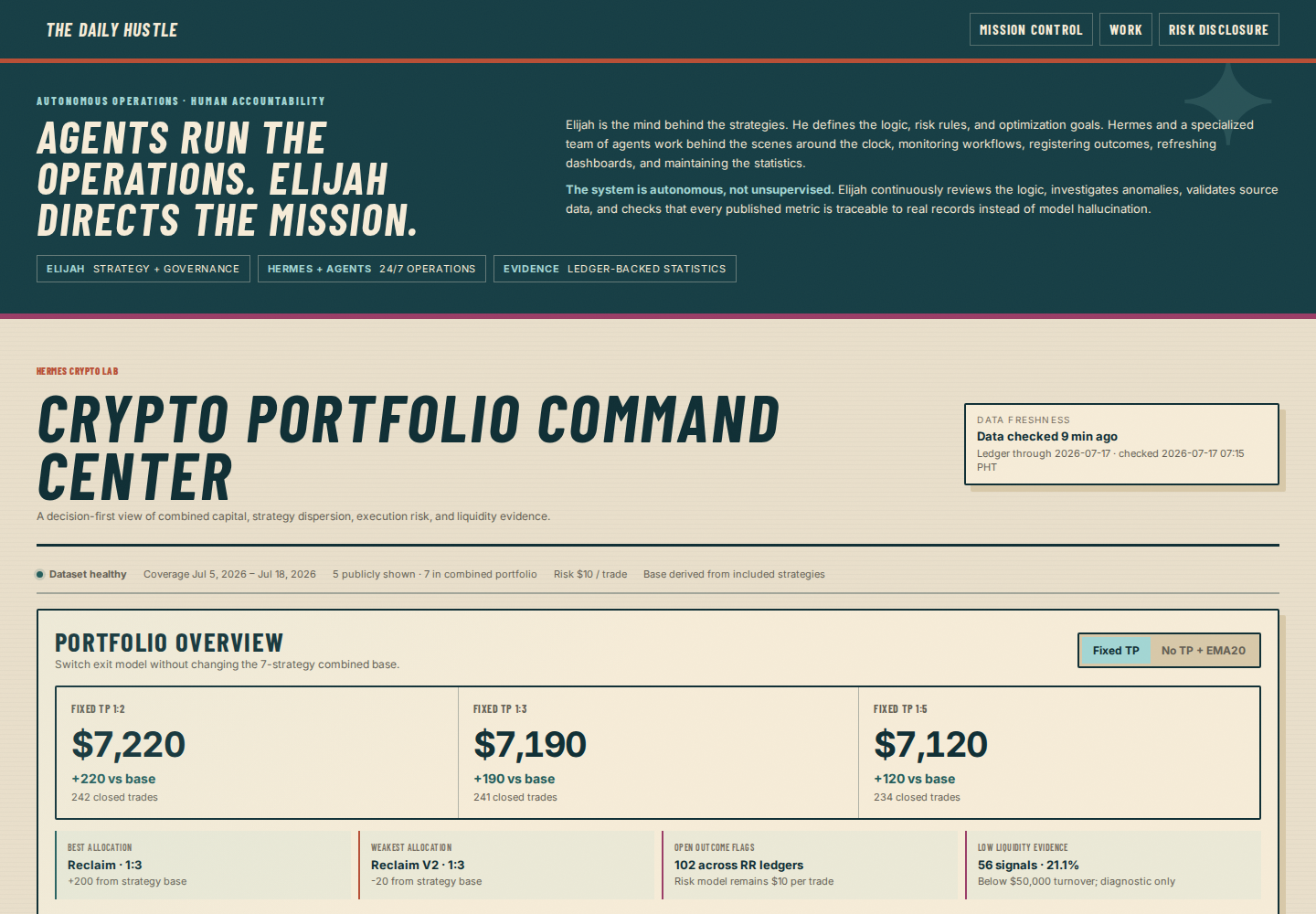
I turned manual setups, scattered screenshots, backtests, and watchlists into a structured system for research, scanning, variant tracking, reports, and dashboard review.
Most people hear "AI trading" and immediately think of one thing:
"Can it tell me what coin to buy?"
And that's honestly the wrong thing to ask.
The better question is:
"Can it turn a manual trading process into a repeatable, measurable, fully autonomous and testable system?"
This. This is the very exact system I've been building together with my Hermes agent.
I've been using Hermes for quite some time now, like I'm running a small quant research desk with my own team of specialized agents. I have a team of agents and automations running a command center, and they've been helping me take strategies I used to trade manually and turn them into autonomous, structured, trackable, systematic workflows.
And it has revolutionized my way of finding edge in the markets.
Not because it magically predicts the market.
But because it handles the nitty-gritty, boring things: research, backtesting, data analysis, end-of-day reports, and end-of-week reports. It tells me what works and what doesn't, and it's all on autopilot, even when I take a vacation. (I think I need one)
- Rules.
- Variants.
- Reports.
- Charts.
- Risk and reward.
- Stops.
- Exits.
- Performance tracking.
- Strategy reviews.
- Daily and weekly accountability.
No more "this setup looks perfect" trades but hindsight says otherwise.
The best rule of thumb here is that a setup either has rules or it doesn't.
And if it does have rules, we should be able to test it, track it, improve it, and run it like a real algo business.
The shift: from manual trading to a full blown AI operating system
Before building this, a lot of strategy work lived in the usual places:
- Screenshots
- Notes
- Discord messages
- TradingView charts
- Gut feel
- "I swear this pattern works"
- Random backtests
- Memory
- Vibes, unfortunately
That can work for a while.
But if you want to scale a trading process, you eventually hit the wall.
You start asking better questions:
- Which setup actually works?
- Which version of the setup is better?
- What are the exact entry rules?
- What invalidates the trade?
- Where does the stop go?
- What exit model makes sense?
- What is the average risk and reward profile?
- What market condition does this work best in?
- Should this become an alert system, a dashboard workflow, or an automated strategy?
- Are we improving the edge, or just renaming the same idea again?
And that my friends is where Hermes becomes powerful.
Hermes lets me run trading work less like a scattered manual trader and more like a quant research and operations desk. It works even if I don't.
So what do I mean by running crypto quant ops with agents?
I'm not saying I have a Wall Street office, a wall full of Bloomberg terminals, and analysts in Patagonia vests yelling across the room.
What I mean is that Hermes gives me the kind of setup a real fund would want around a strategy.
Not just signals.
Everything around the signal too.
- Research
- Rule definition
- Market scanning
- Setup detection
- Backtesting
- Forward testing
- Dashboarding
- Risk and reward tracking
- Variant comparison
- Alert routing
- Trade review
- Daily EOD reports
- Weekly EOW reports
- Performance dashboards
- Iteration
A strategy without all of this is still just an idea.
Once the system around it is running, I can test it, improve it, and see if it's actually worth keeping.
That's the real difference.

How the system works without giving away the secret sauce
I'm not going to share the exact strategy logic, filters, thresholds, scoring, or internal rules publicly.
That's where the edge lives.
But I can show you how the whole thing works.
1. We take manually traded strategies and turn them into rules
A lot of traders have strategies that are real, but messy.
They can see the setup on a chart. They know when it feels right. They understand liquidity, trend, reclaim levels, sweeps, failed breakdowns, compression, expansion, and exit behavior.
But if the rule is only living in your head, it's hard to backtest, automate, teach, scale, improve, compare, or trust under pressure.
So Hermes helps me take that messy version in my head and turn it into actual rules.
Setup type. Market condition. Entry model. Stop behavior. Invalidation. Exit model. Risk and reward. Timeframe. Liquidity context. Review rules.
The goal is simple: turn "I know it when I see it" into "yep, this actually matches the rules."
And honestly, that changes everything.
2. We separate strategies into variants
One of the easiest ways to fool yourself is to mix every version of a setup together.
You think you're tracking one strategy.
But really, you're tracking five different versions wearing the same hoodie.
So inside the command center, I split each version into its own variant.
- Fixed take profit versions
- No take profit versions
- EMA exit versions
- Daily cap versions
- Different risk and reward profiles
- Different filters and conditions
Because one version might be dead weight while another one is where the real edge is hiding.
Without tracking variants, you just feel like something works.
With tracking, you can actually see it.
3. The agents scan the market so I don't have to babysit every chart
This is where the 24/7 part gets real.
The agents keep checking the market, my watchlists, and the strategy rules while I'm off doing something else.
Sleeping. Working. Taking a walk. Pretending I'm finally going to organize my Notion.
I still make the decisions.
I just don't want to waste hours doing the same boring scans over and over again.
If something looks worth checking, the system lets me know. If nothing qualifies, it stays quiet. Way better than staring at charts all day and hoping I don't miss the move.
4. We generate reports that tell the truth
This might be my favorite part.
The system doesn't care about my ego.
It doesn't care if I liked the setup.
It doesn't care if I thought the chart looked clean.
It just tells me what happened.
Every day, I get a report showing what happened: market context, setups, wins, losses, invalid trades, and anything I need to look at.
Then the weekly report zooms out and asks the question that actually matters: are we finding more edge, or are we just keeping ourselves busy?
Sometimes the answer hurts a little. But I'd rather know.
5. We review it like a business, not a casino
The whole point is to stop treating trading like a collection of random good ideas.
If a setup fails, we look at the rule.
If a variant underperforms, we compare it.
If an exit model is weak, we test another one.
If a strategy needs a daily cap, we track it.
If a no take profit model does better, we don't guess why. We dig into the numbers.
That's the quant operations mindset I'm trying to bring into my own trading.
Not because it sounds fancy.
Because if I'm serious about trading, I need to run it seriously too.
What Hermes actually gives me
The biggest unlock isn't one magic bot or one perfect strategy.
It's having a team of agents helping me think, test, document, monitor, and report.
Hermes sits right in the middle between an idea and actually doing something with it.
- One agent can research.
- One agent can monitor.
- One agent can summarize.
- One agent can build dashboards.
- One agent can prepare reports.
- One agent can help turn the strategy into code.
- One agent can route updates into Discord.
- One agent can keep the whole thing organized.
And suddenly, the whole thing feels different.
I'm not sitting there asking AI random questions anymore.
I'm actually running a system.
That's why this has felt so revolutionary for me.
Why this matters for traders
Most traders don't lose because they're stupid.
They lose because their process is all over the place.
They mix setups. Change the rules halfway through. Remember the winners and somehow forget the losers. Judge a strategy from one screenshot. Overtrade when they should wait. Give up too early, then hold on to bad ideas for way too long.
I know because I've done all of that.
Hermes forces me to clean that mess up.
And once the process is clear, I can actually improve it.
If the strategy is bad, I want to know faster.
If the strategy is good, I want to know why.
If one version is better, I want to see it.
If an exit model is carrying the system, I want to track it.
If a filter is killing the edge, I want to cut it.
That's how you stop falling in love with screenshots and start building a real trading operation.
Why this matters as a product
And this can go way beyond my own trading.
The same kind of setup could help other traders, trading groups, educators, signal teams, and even small funds.
Not by promising some magical prediction machine.
That's the cheap pitch.
The real value is running the whole thing better.
- A trading group can track which strategies are actually working.
- An educator can turn setups into something students can follow and test.
- A signal team can keep reports honest and organized.
- A serious trader can stop relying on memory and screenshots.
- A small fund can have its own research and monitoring team without hiring a whole floor of people.
That's the kind of AI trading product I actually believe in.
Not some black box screaming, "Buy this coin."
A system that helps you run the trading side without everything turning into chaos.
The bigger idea
AI isn't that exciting when it's only answering random questions.
It gets exciting when it becomes part of how you actually work.
That's what Hermes has become for me.
It's turning my trading process into something I can track, test, and keep running 24/7.
I can research faster, test ideas cleaner, and get honest feedback without relying on motivation every day.
And honestly, that's the future I'm betting on.
Traders won't just need better indicators.
They'll need better operating systems.
And I want to build those.
Final thought
This isn't about replacing the trader.
It's about helping the trader run things like an operator.
A trader with agents.
A trader with dashboards.
A trader with reports.
A trader with systems that keep working even when he's not staring at the screen.
That's what Hermes has started to become for me.
My own crypto quant operations system.
And yeah, it has been revolutionary.
Crypto Quant Ops FAQ
What is crypto quant ops?
It is the operating system around a crypto strategy: rule definition, research, scans, variant tracking, reports, dashboards, review, and controlled decisions about what deserves further testing.
What does Hermes do in the system?
Hermes coordinates specialized agents, scheduled checks, files, scripts, reports, dashboards, and message routing. Elijah still defines the strategy logic, risk rules, governance, and final decisions.
Does this system guarantee trading performance?
No. It improves process visibility and repeatability, not market certainty. Trading outcomes remain risky and every strategy still needs evidence, monitoring, and human accountability.
Can Elijah build this around another trading workflow?
Yes. The package starts with strategy logic and operating requirements, then covers testing, reports, agent roles, dashboards, documentation, and handoff based on the agreed scope.
Want your trading workflow turned into a system?
Bring the strategy rules, watchlists, alerts, spreadsheets, and current review process. I’ll help map what should become structured logic, what Hermes can operate, and where your judgment should stay in control.
Starting implementation price: $700 USD. Scope, external services, and final appointment are confirmed separately.